Whooping Crane Population Holds Steady at 540, but Work Remains to Secure Species’ Future
ROCKPORT, Texas — The U.S. Fish & Wildlife Service (USFWS) has released its 2025–2026 aerial survey results for the Aransas–Wood Buffalo Whooping Crane population, estimating approximately 540 birds wintered near Aransas National Wildlife Refuge (NWR) on the Texas Gulf Coast. The figure is within the statistical margin of error of last year’s estimate of 557 and reflects a population that has remained above 500 for nine consecutive years — a threshold first crossed after decades of intensive recovery work through international partnership.
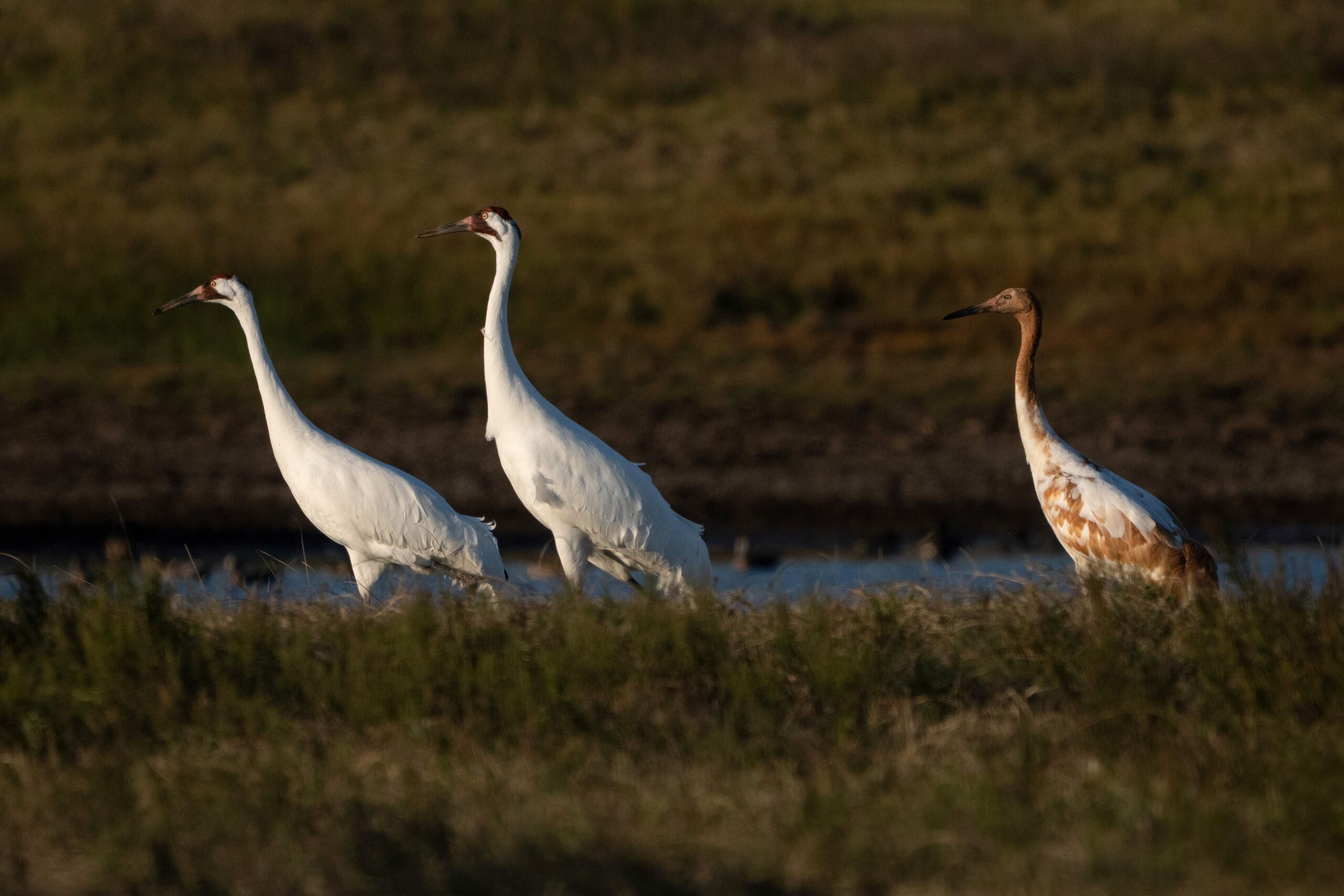
Biologists also estimated 57 juveniles within the primary survey area, which covers approximately 190,250 acres centered on Aransas NWR. Since 1938, the population has grown at a long-term average rate of 4.24% per year — but year-to-year fluctuations are normal. However, data over the last decade shows a slowing population growth rate.
“Holding above 500 for nine years is meaningful, but we shouldn’t become complacent,” said Dr. Carter Crouch, Director of Gulf Coast Programs at the International Crane Foundation. “The slowing population growth rate over the last decade is something we really need to keep an eye on. While the population has been growing for many decades, the threats to the population are also still growing, and we are still losing wetland and grassland habitat at an alarming rate.”
This population also saw a new challenge this year with the first documented cases of mortality from Highly Pathogenic Avian Influenza in the fall of 2025.

Loss of key habitat, like the coastal salt marsh pictured above, remains the leading threat to crane populations globally.
Whooping Crane Range Expanding
An additional 52 Whooping Cranes were recorded outside the primary survey area this season, based on data from secondary aerial surveys, a GPS tracking study, public sightings reported through Texas Whooper Watch, eBird, and iNaturalist, and a road survey of an inland wintering area by International Crane Foundation and Texas Parks and Wildlife Department staff.
Notably, eight Whooping Cranes remained at Salt Plains National Wildlife Refuge in Oklahoma throughout the winter — one of the first documented cases of the species overwintering in that state. The discovery was made in part through sightings reported during the annual Christmas Bird Count.
“Finding eight birds overwintering in Oklahoma for the first time is significant,” Dr. Crouch said. “It tells us birds are using a wider range of winter habitat, which indicates a more resilient population, but it could also be a response to our changing climate. We need more years of data to understand what it means, but it highlights that community science reporting is an essential part of how we track this species wintering outside of the primary survey area.”

Led by Dr. Carter Crouch (center), Director of Gulf Coast Programs, International Crane Foundation staff complete Whooping Crane surveys along the Texas Gulf Coast.
Recovery Is a Long Game
When Whooping Cranes were listed as endangered in 1967, only around 50 individuals remained. The species’ recovery to more than 500 birds is the result of sustained federal and international partnership, habitat protection, and decades of field work by biologists across the continent. The International Crane Foundation has been a partner in that effort, contributing to research, reintroduction programs, habitat conservation, policy initiatives, and education and outreach.
The species remains endangered. The Foundation and its partners continue to work toward the conditions — sufficient habitat, population growth, and reduced mortality — that would support the species’ long-term survival in the wild.