Crane FAQs
Q: How many kinds of cranes are there, and how many does the International Crane Foundation have?
A: There are 15 species in the crane family Gruidae. Ten of the 15 species are listed as threatened or endangered.
We have all 15 crane species at the International Crane Foundation. The total number of resident cranes varies from season to season, but typically ranges from 100 to 120. The Crane Discovery Center, located at our headquarters, is the only place in the world where you can view all 15 species of cranes. The rest of the resident flock is housed at our breeding facility, Crane City.
Q: Which crane is the rarest?
A: Whooping Cranes are the rarest crane species. Red-crowned Cranes are the second rarest crane species. Siberian Cranes are considered the most endangered crane species.
Q: How long does a crane live?
A: In the wild, cranes typically live 20 – 30 years with some variation between species. Cranes in human care may live to 40-50 years due to protection from predators, high-quality food, and veterinary care. The oldest known crane was a Siberian Crane that lived at a zoo and reached 83 years old!
Q: How can you tell male and female cranes apart?
A: In most crane species, males and females look very similar – a few experts may be able to make a good guess based on behaviors or calls. At the International Crane Foundation, we determine the gender of the resident cranes through blood work.
Q: What predators might prey on cranes?
A: Crane predators vary from place to place since cranes live in so many regions. In the United States, animals such as raccoons, foxes, and coyotes may prey on crane eggs or young. Adult cranes can usually escape these predators, but cannot escape large birds of prey such as golden eagles. The crane’s large size, aggressive disposition, and ability to fly can help protect it from predators.
Q: Do people hunt cranes in North America?
A: Yes, some people hunt Sandhill Cranes in North America for recreational purposes. Multiple U.S. states and three Canadian provinces have legal hunting seasons for Sandhill Cranes.
Q: How far and how high do cranes fly?
A: Lesser Sandhill Cranes have the longest migration, flying between their breeding and wintering grounds as far as northeastern Siberia and northern Mexico each year. Demoiselle Cranes, the smallest crane species, migrate over the Himalayas, crossing the mountain range at altitudes of up to 26,000 feet to reach their wintering areas in India.
Q: Do all cranes migrate?
A: Not all crane species migrate, though most move seasonally based on availability of resources, like food.
Q: How good is the vision of a crane?
A: Visual acuity is difficult to determine because seeing something depends on several conditions. Birds often look for certain shapes or patterns. For example, cranes will often see large predatory birds long before we do, but they deliberately look for them while we do not. In addition, we rarely think of eyesight as an adaptation for flight, but birds, including cranes, require excellent eyesight to fly.
Q: Do cranes have a sense of smell?
A: Perhaps. Studies show that some bird families, including cranes, have enlarged olfactory centers in the brain. However, our experience shows that cranes rely on hearing and vision rather than the sense of smell to detect food, other cranes, or enemies.
Q: How much does a crane weigh?
A: Demoiselle Cranes, the lightest species, weigh four to seven pounds, and Red-crowned Cranes, the heaviest, weigh up to 22 pounds.
Q: What is the tallest crane?
A: Cranes are among the tallest flying birds in the world. Sarus Cranes stand at six feet tall, making it the world’s tallest flying bird.
Q: What is their wingspan?
A: From five to eight feet, depending on the species.
Q: Why do cranes stand on one leg?
A: Cranes stand on one leg when they are roosting, or resting, and tuck one leg up into their body to keep it warm. Birds, like mammals, are warm-blooded. Because cranes have higher temperatures and smaller bodies than humans, they lose body heat more readily.
Q: What is a precocial bird?
A: Precocial describes species capable of a high degree of independent activity from birth chicks. Cranes and other ground-nesting birds hatch with down feathers, open eyes, and the ability to leave the nest within hours of hatching. Songbirds are altricial, meaning they hatch naked and blind, and are dependent on their parents for food.
Q: What is imprinting?
A: Imprinting is a rapid learning process that takes place in young precocial birds. Imprinting occurs when young birds follow and identify the first large moving object they see as a parent. They learn their parents’ behavioral and physical characteristics and form impressions that remain with them for life. The process of imprinting is still not well understood. For instance, there are probably several stages of growth where imprinting is important. There is parental imprinting, when the chick determines its species, and sexual imprinting, where the chick determines what it will seek in a mate as it matures.
Q: What do the cranes eat?
A: Cranes are omnivores. In the wild they eat plants, tubers, insects, small animals and nearly anything they can catch. Chicks eat mostly insects during the spring since their fast growth requires high-protein foods. Later in the summer, they will begin to feed on small mammals and amphibians, along with roots and tubers.
At the International Crane Foundation, the resident cranes eat “crane chow,” a special blend of soy, alfalfa, fish and cornmeal, with a special vitamin supplement. All species get the same diet, although protein content changes with the season and the birds’ ages. Breeding females also get calcium chips in spring to help with eggshell formation, and all the cranes get shelled corn in winter, to provide extra carbohydrates. Cranes can also forage in their habitats at the International Crane Foundation – they have been observed eating plants or catching crayfish, insects, amphibians, and small mammals. We do not stock any of the ponds at the Crane Discovery Center.
Q: Do cranes cause crop damage?
A: Yes, on occasion they will. In Wisconsin, cranes may cause crop damage in corn and potato fields, where the birds may feed on newly sprouted corn plants or maturing potato tubers. Our North America Program staff is involved in a long-term study of crop depredation in a study area located near Briggsville, Wisconsin. Our team is working with local farmers to develop a substance – known by the trade name Avipel – to put on corn kernels that will taste bad to cranes. Our research has shown that Avipel will deter cranes from feeding on corn seeds in treated fields. Farmers throughout the world are faced with this challenge, and solutions developed in Wisconsin may be useful for farmers in other countries.
Q: Do chicks know how to eat when they are hatched?
A: No. In the wild, crane chicks follow their parents and are fed by them. Chicks peck food from their parents’ beaks. When the crane chicks are two to three months old, they are very independent, pecking and probing on their own, and finding food items by trial and error. Occasionally, the parents may still present new food items to the chicks. Feeding the chick also may help keep the bond between the chicks and parents strong during migration and the chick’s first winter.
Q: How many eggs do cranes usually lay?
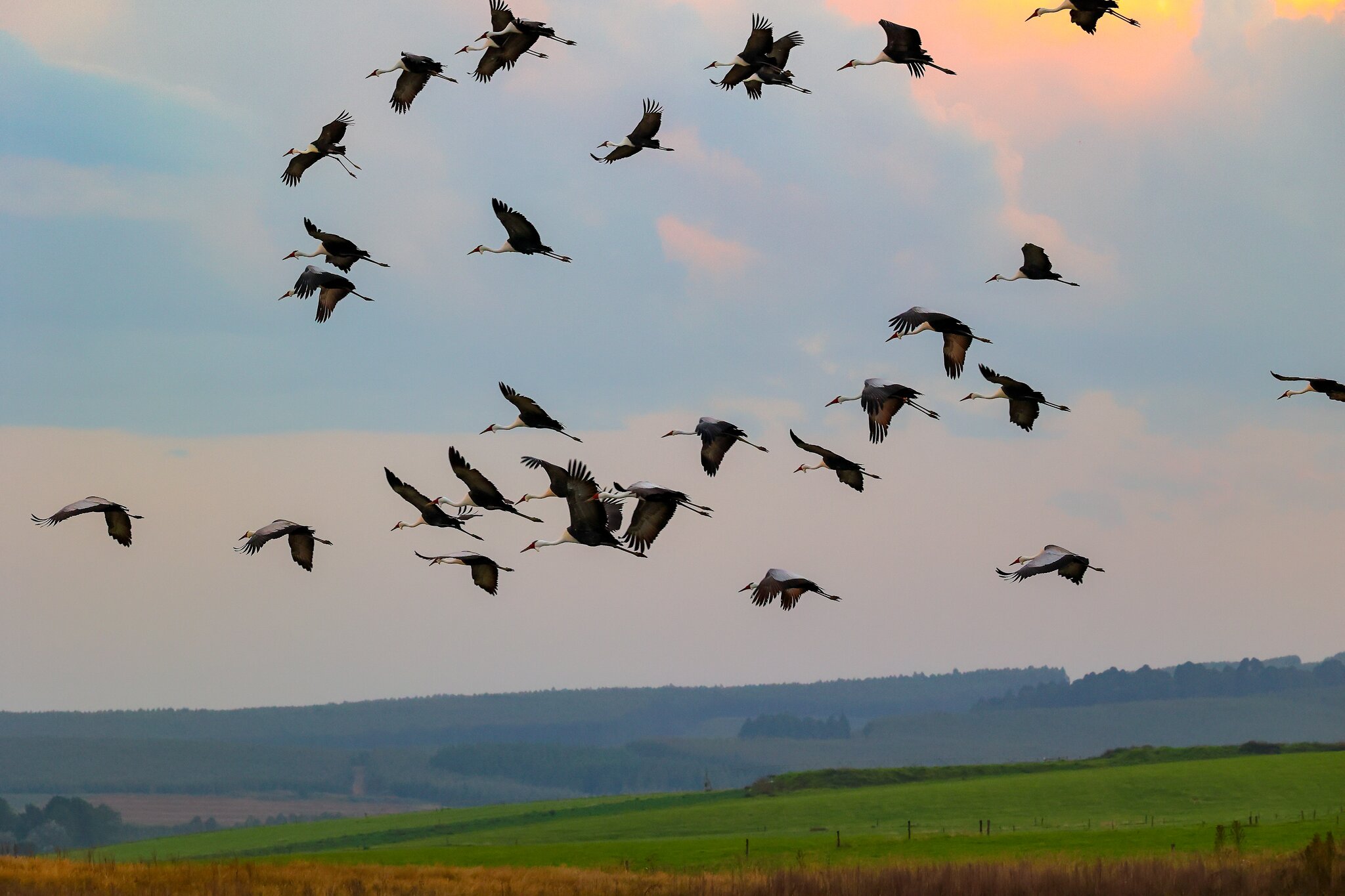
A: Cranes usually lay two eggs. However, the crowned cranes may lay up to five eggs in a single clutch, while the Wattled Cranes may lay only one egg.
Q: Why do cranes lay two eggs when usually only one chick survives?
A: Migration, territory defense, and breeding are difficult, energy-consuming activities that place the adults at risk. If cranes only laid one egg and it was infertile, or the chick died, the birds have expended that energy in a futile effort. The second egg could be considered insurance against failure. In years when food is abundant, both chicks may survive.
Q: How old are cranes when they first breed?
A: Most species mature and begin breeding in human care at three years of age. In the wild, we think cranes are at least four to five years old before they nest successfully. Some species, like the Siberians, may take even longer – up to six or seven years.
Q: How big are crane eggs?
A: The size of a crane egg depends on the species. The larger the crane, the larger the egg. The largest of crane eggs is about 4.6 inches long. They are usually tan with brown speckles.
Q: Do cranes ever select a mate from another species?
A: On rare occasions in the wild, Brolgas have paired with Sarus Cranes, and Eurasians have paired with Hooded Cranes. Their offspring are fertile.
Q: What is the male’s role while waiting for eggs to hatch?
A: A male will also incubate the eggs, but his primary task is to protect the territory. Incubating pairs trade places about every two hours during daylight hours. This gives each bird a chance to stretch, exercise, and feed. At night, the female incubates while the male stands guard. The male is often the first to feed the chicks.
Q: Cranes mate for life. What happens if one dies?
A: If a mate is lost, the remaining bird will usually find another partner.
Q: What is isolation rearing?
A: Chicks raised by isolation rearing are fed by a crane puppet and exercised by an aviculturist disguised as a crane. The chicks hear only other cranes, either on tape or in a nearby enclosure. These birds may later be introduced to wild flocks of cranes where they learn additional survival skills.
Q: Why do you raise cranes in isolation from humans?
A: Birds raised in isolation from humans are better adapted for living in the wild. Using this method, we are able to help increase the number of cranes in wild flocks, such as Whooping Cranes in the Eastern Migratory and Louisiana Populations.
Q: How many people visit the International Crane Foundation each year?
A: Approximately 25,000 people visit each year. In addition, we reach thousands of people each year through our website, international programs, and off-site programming.
Q: Why did you move from our original site?
A: The people who let us use the old site, Norman and Claire Sauey, wanted to use the farm again themselves. In addition, at the old site, the birds and staff were getting overcrowded. In the early 1980s, we relocated to our present location on Shady Lane Road, just a few miles north of Baraboo, Wisconsin.
Q: How much land does the International Crane Foundation have?
A: Our Headquarters in Baraboo, Wisconsin, is currently about 260 acres. Much of our site (about 120 acres) is restored prairie and oak savanna.
In 2025, we established Wolfberry Whooping Crane Sanctuary through the acquisition of a 1,150-acre property along the Texas Gulf Coast where Whooping Cranes spend the winter.
Q: What is Crane City?
A: “Crane City” is the breeding area at the back of the property, which houses about 80 cranes. It is off-limits to the public because breeding cranes are sensitive to human disturbance.
Q: Are there any other institutions with cranes in human care?
A: Many zoos and research centers have cranes, but the International Crane Foundation is the only place to view all 15 species. Our Foundation is also the only organization making a coordinated, comprehensive effort to save critical habitat, propagate cranes in captivity, reintroduce them to the wild, and educate people living nearby about their relationship to wetlands and cranes.
Q: Who names the cranes at the International Crane Foundation?
A: Generally, the Crane Conservation Department staff names them. Sometimes they are named after people (like O’Keeffe), or geographic locations (Aransas), and others are named after cultural attributes (Haiku, a form of Japanese poem).
Q: What do the resident cranes at the International Crane Foundation do in the winter?
A: The Wisconsin winter is similar to conditions in the wild for several of the cranes. Species that are sensitive to cold are moved indoors at night or during the cold season under the care of our specialized crane care staff.
Q: How many people work here?
A: The International Crane Foundation has more than 175 staff around the world. About 60 permanent staff are based at our headquarters in Baraboo, WI. In addition, we work with many volunteers, student interns, seasonal employees and graduate students. To find out about employment opportunities, visit our website.
Q: Where does your funding come from?
A: The International Crane Foundation is a non-profit organization. Much of our support is from private sources such as grants and donations. Memberships, entrance fees, and income from the gift shop also help. The federal government pays us a yearly stipend to take care of each Whooping Crane kept here.