Going the Distance to Understand the Daily Movement of Whooping Cranes
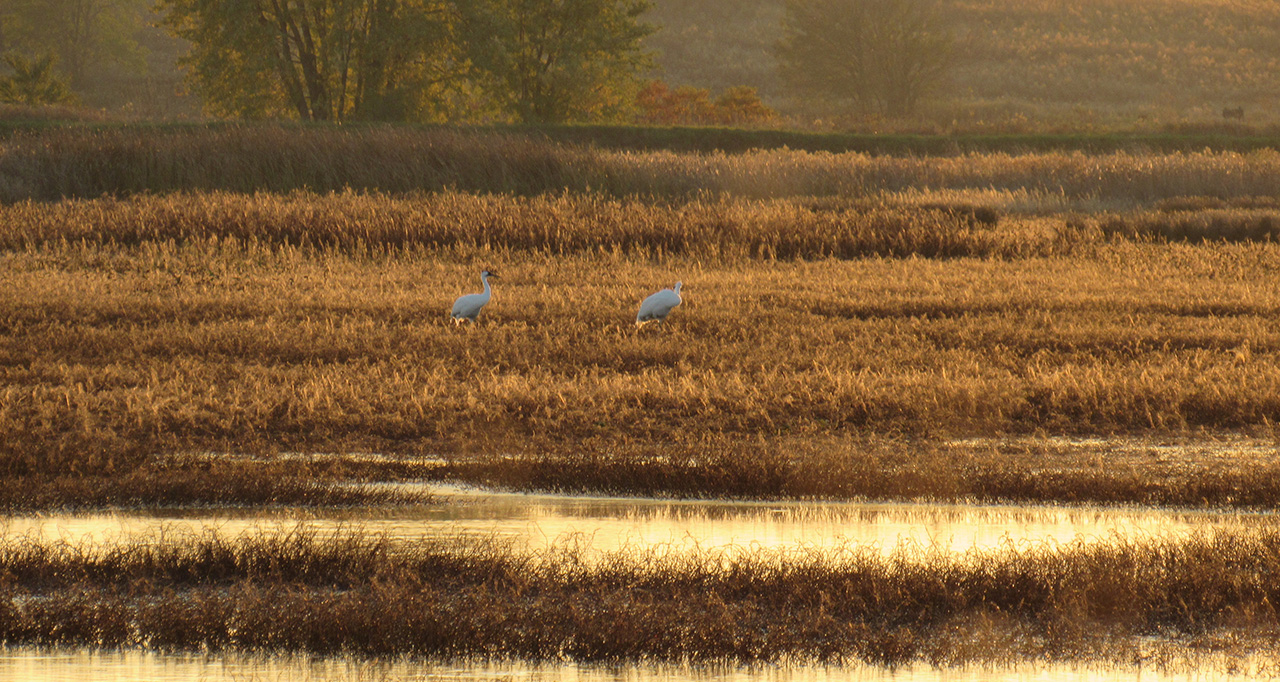
Photo by Dan Kaiser
For decades, conservationists have worked to combat threats that nearly drove the Whooping Crane to extinction. Their population hit a historic low of only 21 individuals in the wild in the 1940s. As part of the effort to save the species, a population of migratory Whooping Cranes was reintroduced to Wisconsin in 2001, known as the Eastern Migratory Population, or EMP. Today, the EMP consists of around 70 individuals who spend their summers in Wisconsin before migrating further south for the winter, mostly in Alabama and Indiana. Through this reintroduction and countless other conservation measures, there are now about 700 Whooping Cranes in the wild in three populations. Despite this impressive growth, threats continue to emerge that threaten the species’ survival, and these must be met with creative research, dedicated partnerships, and decisive action to safeguard the future of Whooping Cranes.
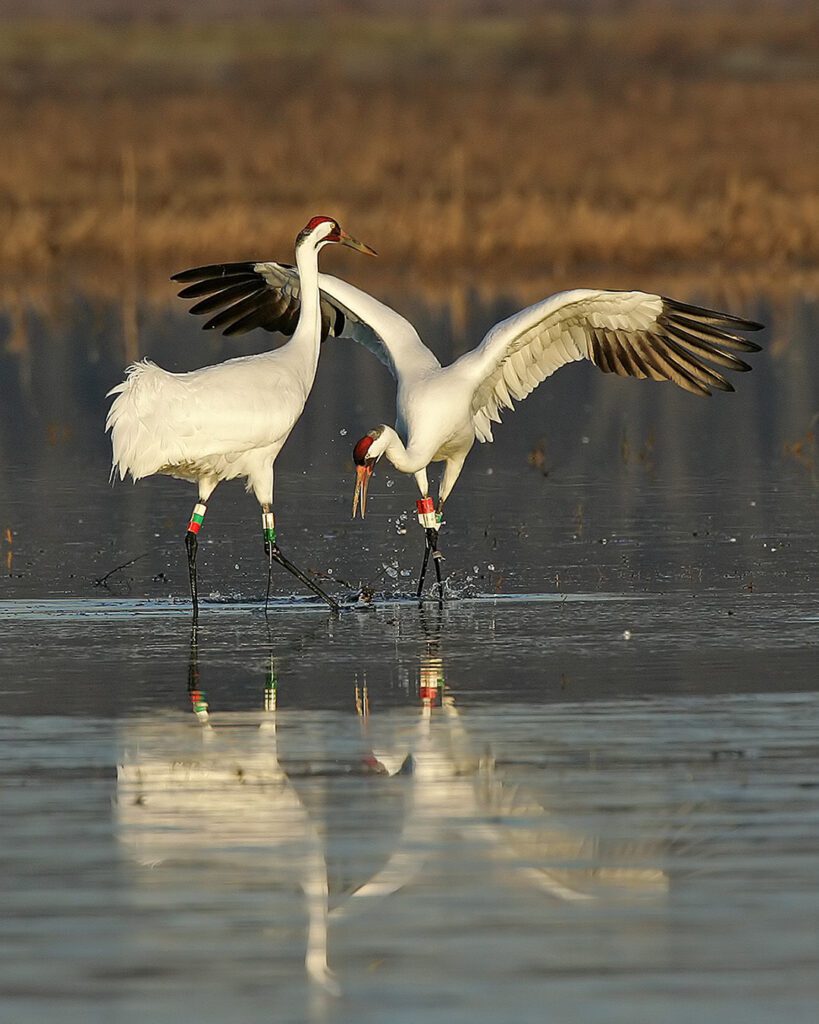
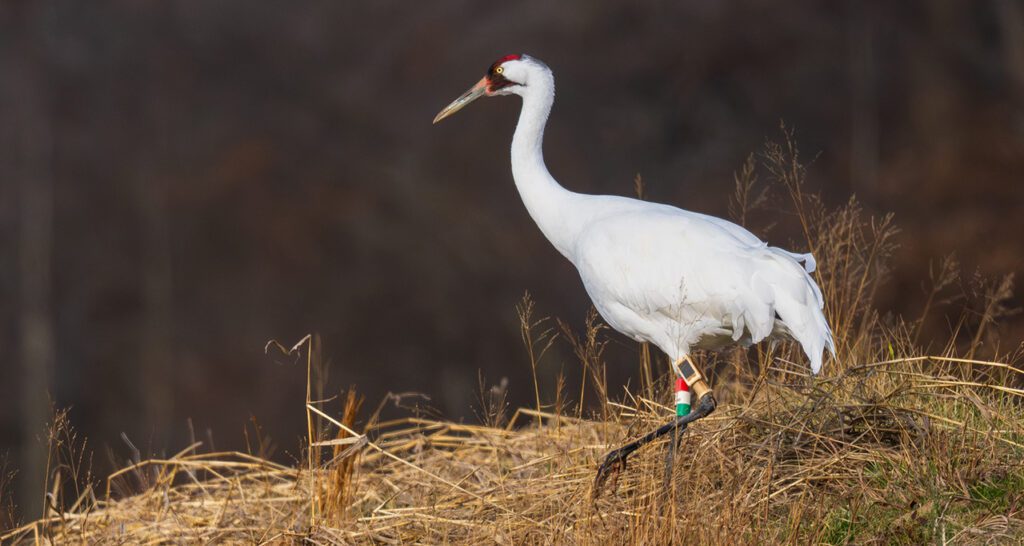
A pair of Whooping Cranes, each with unique colored bands, dancing in a wetland at Goose Pond Fish and Wildlife Area in Indiana. Photo by Dan Kaiser
One threat to Whooping Cranes is the loss of habitat to energy development. We all rely on energy in our day-to-day lives, and as the human population grows, so does our demand for energy. Green energy, such as solar and wind, has the potential to help us meet these needs in a sustainable manner, but it requires a lot of space to collect and powerlines to transport energy. When potential Whooping Crane habitat is lost due to the development of energy infrastructure, it poses a twofold threat: first from habitat loss on the ground, then from increased risk of fatal collisions with powerlines.
The International Crane Foundation works with energy companies worldwide to minimize the risk of powerline collisions through burying powerlines, marking them with devices that make them more visible to birds, or siting new development far enough away from critical crane habitat. But this raises the question: how far is far enough when it comes to keeping energy infrastructure away from Whooping Cranes?
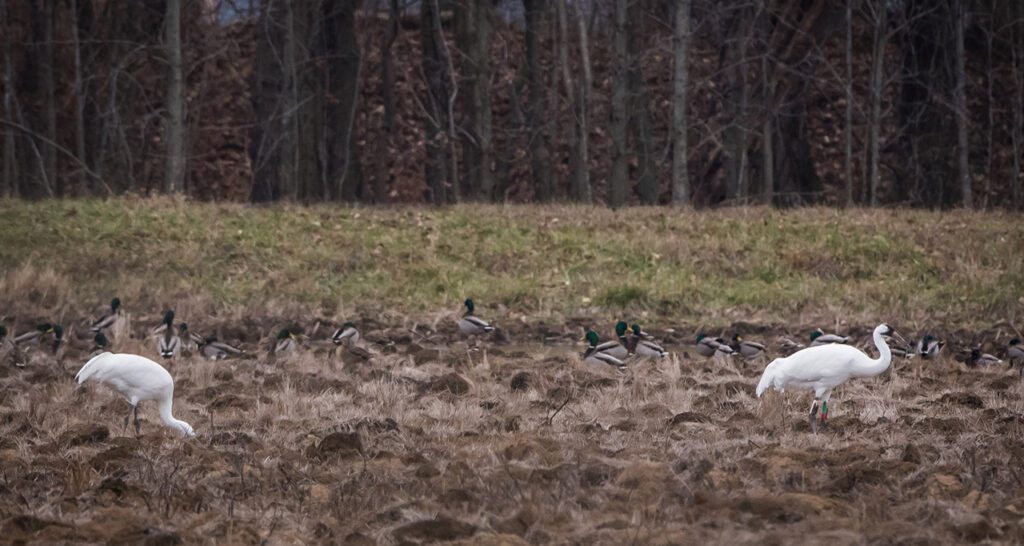
This is a question our research team wanted to answer at Goose Pond Fish and Wildlife Area in Indiana, or Goose Pond for short, where about 16% of all the Whooping Cranes in the EMP spend their winters. Although the vast prairies and wetlands of Goose Pond are protected from human development, many of the Whooping Cranes that stay there over winter travel to the surrounding privately owned agriculture fields during the day, presumably to find food such as waste grain from previous harvests. There are already solar panel fields less than 10 miles away from Goose Pond, and if expansion were to continue, it is likely that additional energy infrastructure would replace some of the farm fields in the area. If built too close to, or within, areas the Whooping Cranes go to feed, it could be detrimental to the population.
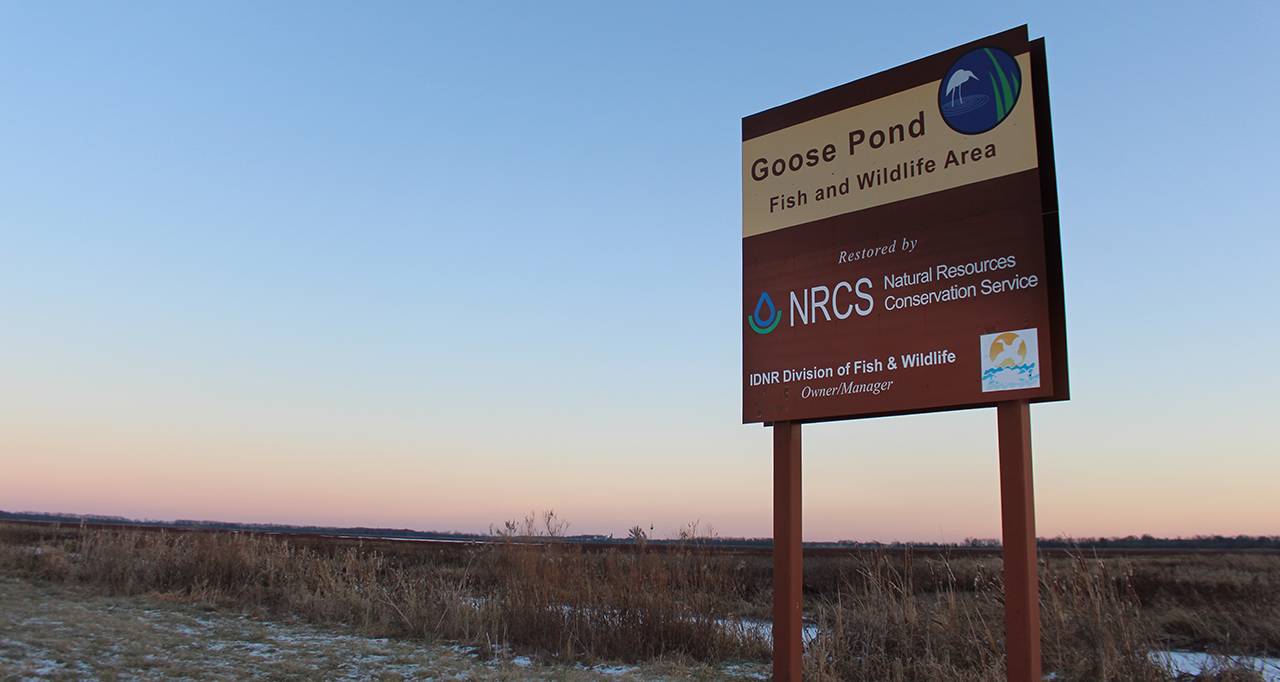
The sign for Goose Pond Fish and Wildlife Area. In the background are acres of open wetlands and prairies. Photo by Dan Kaiser
To predict how far the Whooping Cranes at Goose Pond were traveling away from the protected lands each day, we used location data collected from remote transmitter devices. These devices, which go on the crane’s leg, are deployed as part of the ongoing effort to track Whooping Cranes in the EMP. In fact, each EMP Whooping Crane has a unique band combination so we can distinguish between individuals. The transmitters are lightweight, solar powered, and work by sending signals through cell tower networks. Not all EMP Whooping Cranes have these location devices, but there were 11 Whooping Cranes that had spent winters at Goose Pond while equipped with these transmitters. We analyzed their location data using Geographic Information System, or GIS, tools. We measured the distance between the point where each Whooping Crane spent the night at Goose Pond and their furthest location the next day outside of Goose Pond, which we called their maximum daily dispersal distance. This can also be thought of as how far they traveled on any given day to forage sites.

International Crane Foundation researchers carefully put a remote location transmitter around a Whooping Crane’s leg. Photo by Nicki Gordon/International Crane Foundation
With the data from the transmitters, we obtained 1,048 unique maximum daily dispersal distances, each representing a different day of movement by one of the 11 Whooping Cranes. We found that Whooping Cranes at Goose Pond usually traveled less than 12.56 kilometers, or about eight miles, away from where they roosted the previous night. We noticed a significant difference in the average daily dispersal distances of some Whooping Crane individuals. This could be due to several reasons, such as weather conditions, food availability, or whether a crane is alone or in a group. Although our estimated buffer distance would include most birds using Goose Pond, this variation highlights the need to evaluate Whooping Crane space requirements on a case-by-case basis, as no two cranes or landscapes are the same.
We now know that a buffer distance of 12.56 kilometers around Goose Pond would encompass most of the daily travels of Whooping Cranes that stay at the property over the winter. With the knowledge gained in this study, we can prioritize areas for protection and mitigation of threats, especially from energy development. By building partnerships with communities, energy companies, and conservationists across the flyway, we can reach solutions that benefit both people and the cranes they share the land with.
Thank you to Hillary Thompson, Allisyn-Marie Gillet, Amy Kearns, and Andy Caven, with whom I coauthored the paper “Maximum Daily Dispersal Distance of Wintering Whooping Cranes at Goose Pond Fish and Wildlife Area, Indiana,” for your contributions and for allowing us to share this work.
Story submitted by Alicia Ward, Outreach Biologist, International Crane Foundation.
Reference:
Ward, A. M., Thompson, H. L., Gillet, A. T. Y., Kearns A. J., and Caven A. J. 2025. Maximum Daily Dispersal Distance of Wintering Whooping Cranes at Goose Pond Fish and Wildlife Area, Indiana. Proceedings of the North American Crane Workshop 16:195-202.
Published January 12, 2026