Crane Count Classic
Capturing the History of the Early Years of the Annual Midwest Crane Count
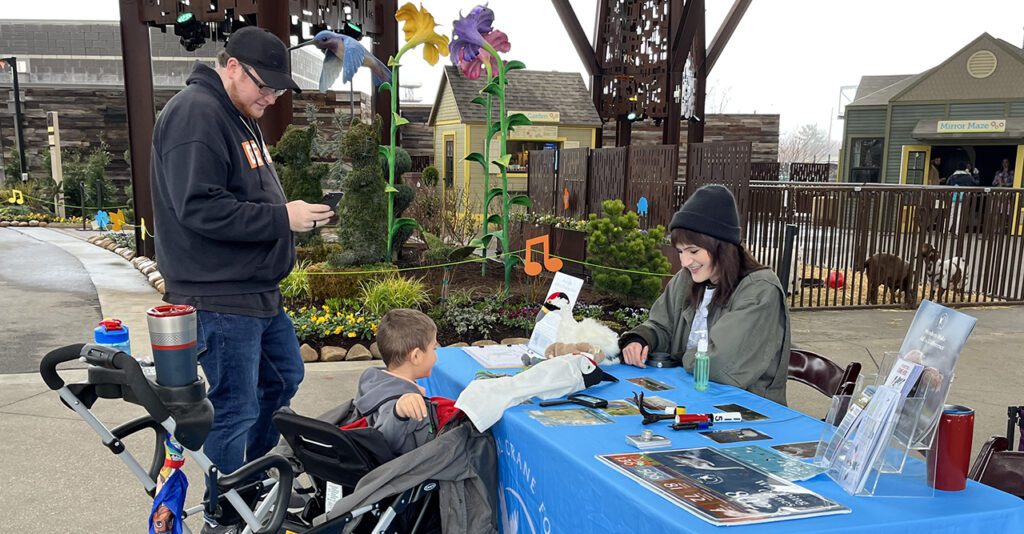
This article is reproduced with permission from the Wisconsin Wetlands Association in celebration of the Annual Midwest Crane Count’s 40th Anniversary in 2016.
Each year in mid-April, more than 2,000 volunteers travel to their local wetlands and favorite birding locations to participate in the Annual Midwest Crane Count. In celebration of the 40th anniversary of the Crane Count, Wisconsin Wetlands Association member Karen Voss tracked down the history of the count’s inception. Click here for more information about the Crane Count.
By Karen Voss
I encountered my first Sandhill Crane in the spring of 1973. As a first-year graduate student and an ornithology teaching assistant, I was weak at the knees with my inexperience, yet loving every minute. Drs. George Archibald and Ron Sauey, recently of Cornell University, were just establishing the International Crane Foundation on the northern outskirts of Baraboo, Wis.
Few researchers studied Sandhill Cranes until the early 1970s, when a small Wisconsin explosion of interest and advocacy for cranes and wetlands occurred. Dr. Archibald began extensive field surveys, hoping to eventually establish a wild population of Whooping Cranes in Eastern North America. At UW–Stevens Point, Ernie Gluesing, a wildlife biology graduate student under Dr. Lyle Nauman, surveyed the state’s population and estimated a total of about 850 Sandhills. On the heels of Gluesing’s research came the work of several more of Nauman’s graduate students, all working to better understand the ecology of Sandhill Cranes.
Meanwhile, Jim and Libby Zimmerman’s fight in 1969 to protect wetlands from a freeway expansion in Madison marked the beginning of what was to become the Wisconsin Wetlands Association. Under the Zimmermans’ guidance, the Wisconsin Wetlands Association became a broad-based organization working on education and advocacy.
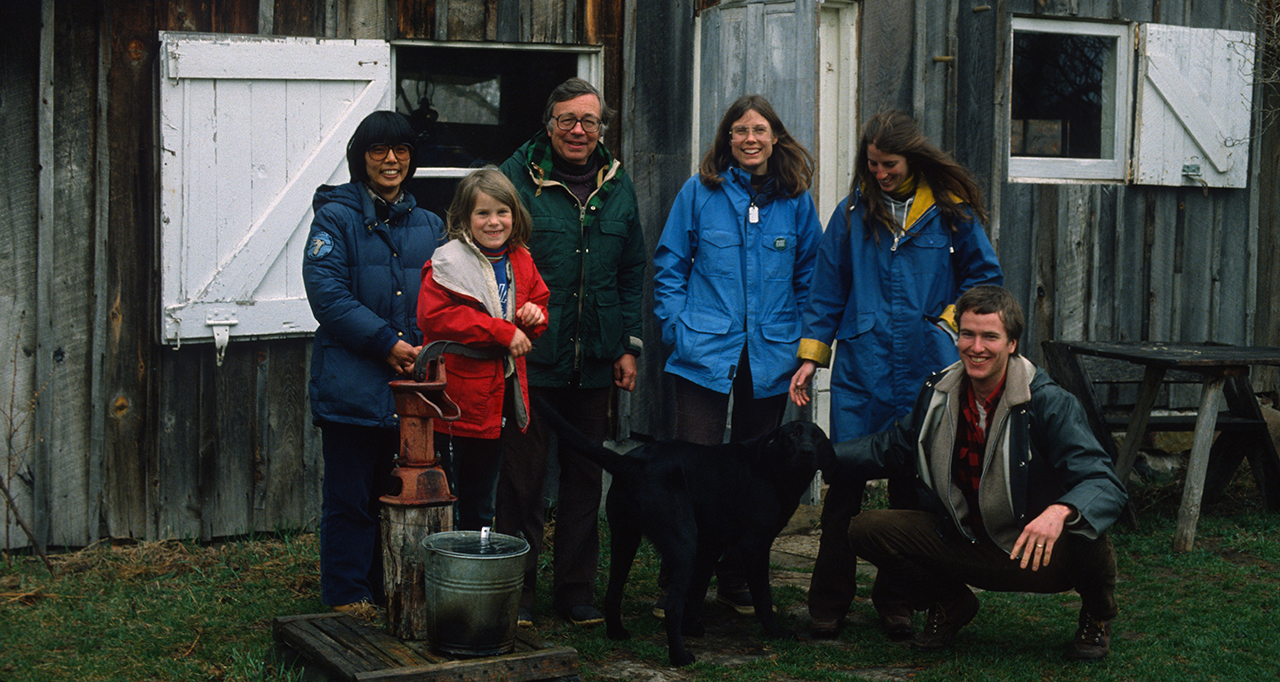
Frank Graham Jr., field editor for National Audubon Magazine, took part in the 1980 Crane Count, also visiting the Aldo Leopold Shack. Pictured: Kyoko Archibald, Jessica Voss, Frank Graham Jr., Karen Voss, Susan Leopold, and Scott Freeman. Photo by Martin Voss
By the mid-1970s, the common interests of the International Crane Foundation, Wisconsin Wetlands Association, Wisconsin Department of Natural Resources, and wildlife researchers began to coalesce into a collaborative effort. With the International Crane Foundation’s encouragement, and with guidance and advice from graduate student Alan Bennet, a high school teacher and his class counted cranes in Columbia County. With that first citizen survey effort, the need for more “eyes on the sky” and “feet on the wet ground” became evident.
After graduating from UW-Stevens Point in 1977, Charlie Luthin worked at the International Crane Foundation, assisting with early citizen survey efforts. The beginnings of the Crane Count began to take shape in 1978 through a collaborative planning effort involving the Wisconsin Wetlands Association, the Madison Audubon Society, and the International Crane Foundation. Five counties were surveyed that year: Columbia, Sauk, Dane, Dodge, and Jefferson.
Luthin began graduate school at UW-Madison in 1979 and became active in the Madison-based Wisconsin Wetlands Association. With Charlie’s leadership, they agreed to take over the lead responsibility for the Crane Count, freeing the International Crane Foundation to spend time on other valuable research.
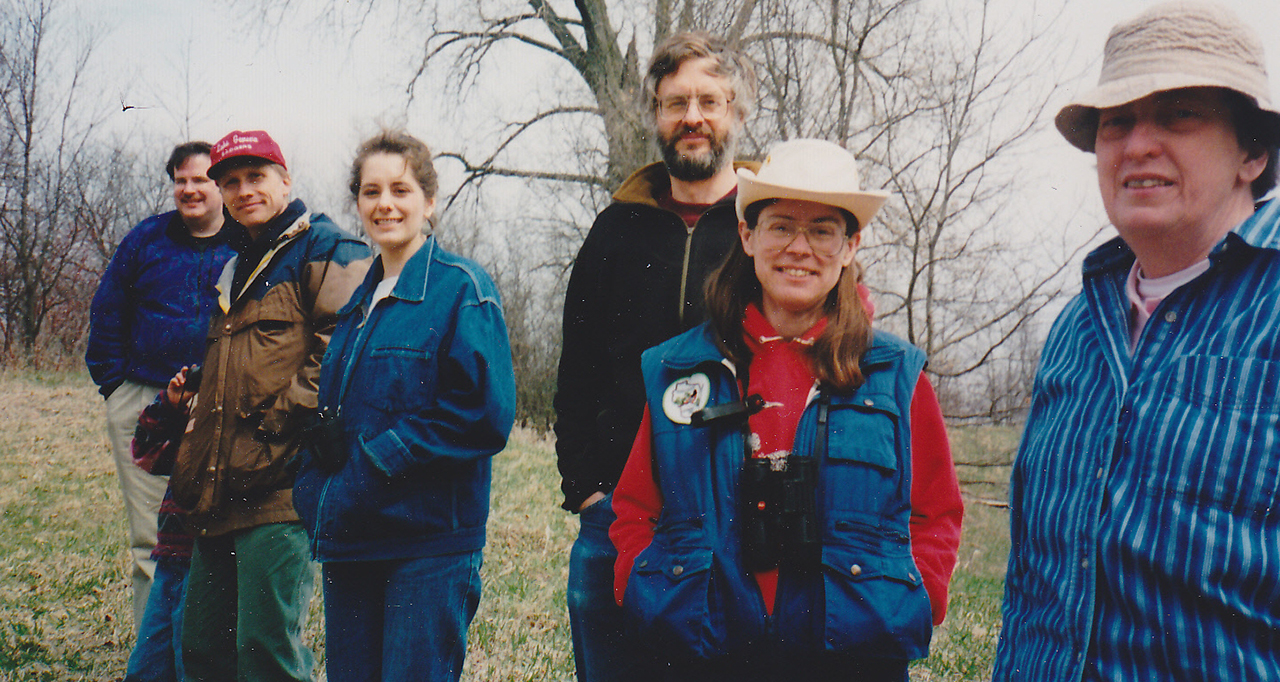 Crane counters Claude Taylor, Rich and Celeste Moen, Jim & Karen Etter Hale, and Libby Zimmerman at Red Cedar Lake in 1996. Photo by Rosie Meinholtz
The Crane Count soon became the culmination of the Wisconsin Wetland Association’s Wetlands Week, an annual springtime celebration of wetlands. During this period, the number of Crane Count participants (and cranes) steadily grew. With its near-statewide scope and established consistency in data collection, the Crane Count became a critical tool for assessing the abundance and distribution of cranes and documenting the population’s expansion into previously unused wetlands. By 1985, the International Crane Foundation’s growth enabled it to resume management of the Crane Count, organizing county coordinators and tabulating results, while the Wisconsin Wetlands Association remained a strong source of participants.
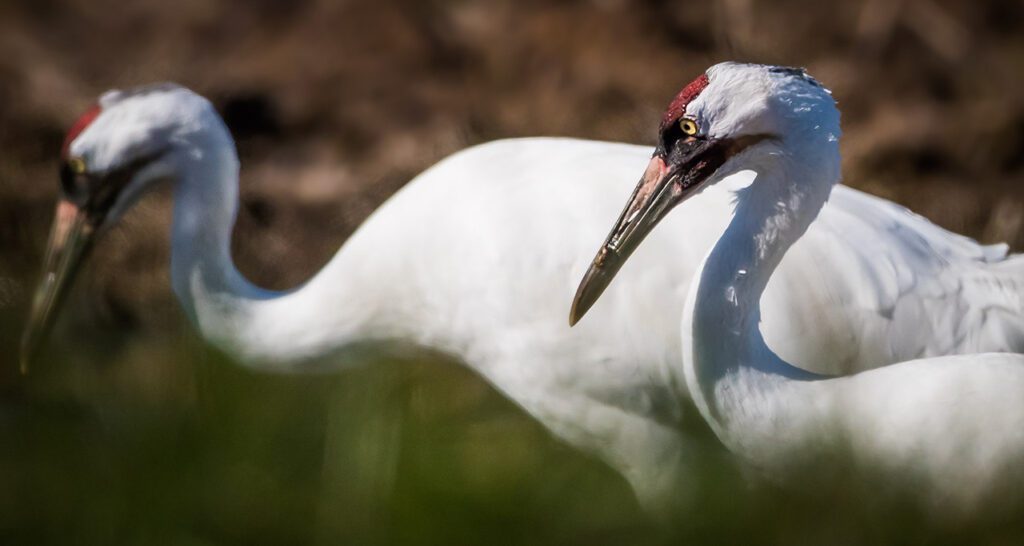
In mid-1990, surrounding states joined the Count, and the name of the event was changed to the Midwest Sandhill Crane Count. Ten years later, coming full circle from Dr. Archibald’s 1972 vision of reintroducing Whooping Cranes to Wisconsin, the Count was renamed again to the Annual Midwest Crane Count, reflecting the promising Whooping Crane reintroduction efforts. In 2012, the event took a big step into the electronic age, with participants entering data directly into the massive online database, eBird.
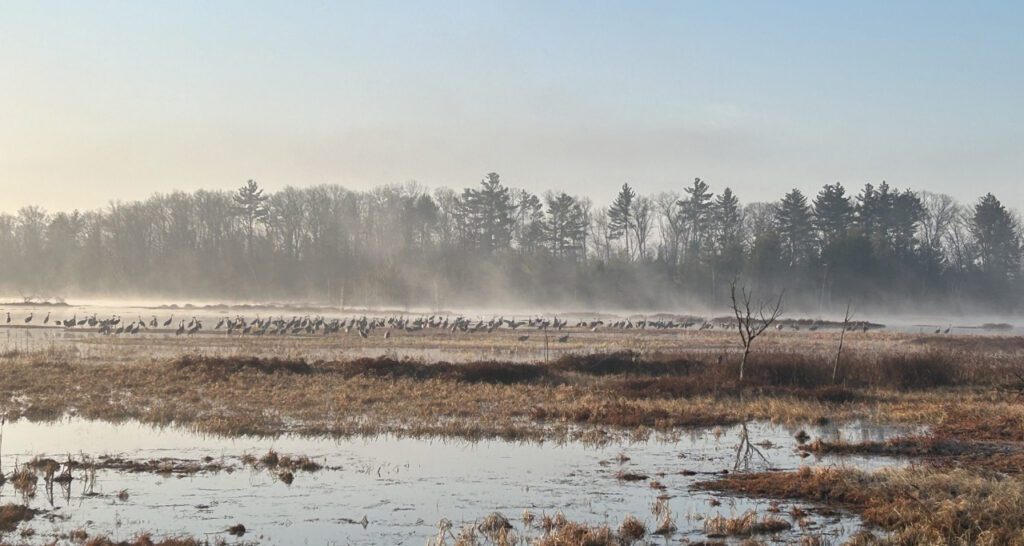
Through the forty years of Crane Count’s history, some things remain unchanged. The Crane Count continues to be an annual rite of spring for many. Before dawn on a mid-April day each year, high school classes, 4-H kids, life-long and first-time birders troop through the dark to their assigned wetlands. The collective steam of hot coffee cups rises into the misty morning air. A tentative robin calls, and the last of the nocturnal woodcock peents reach listening ears. Finally, a distant bugle of cranes or the swish of near-silent coasting cranes passing overhead is heard. Pens and pencils come out of pockets, binoculars are lifted, and for two hours, several thousand hardy souls experience an ancient dawn on a wetland, much as it may have been experienced for the past millennia.
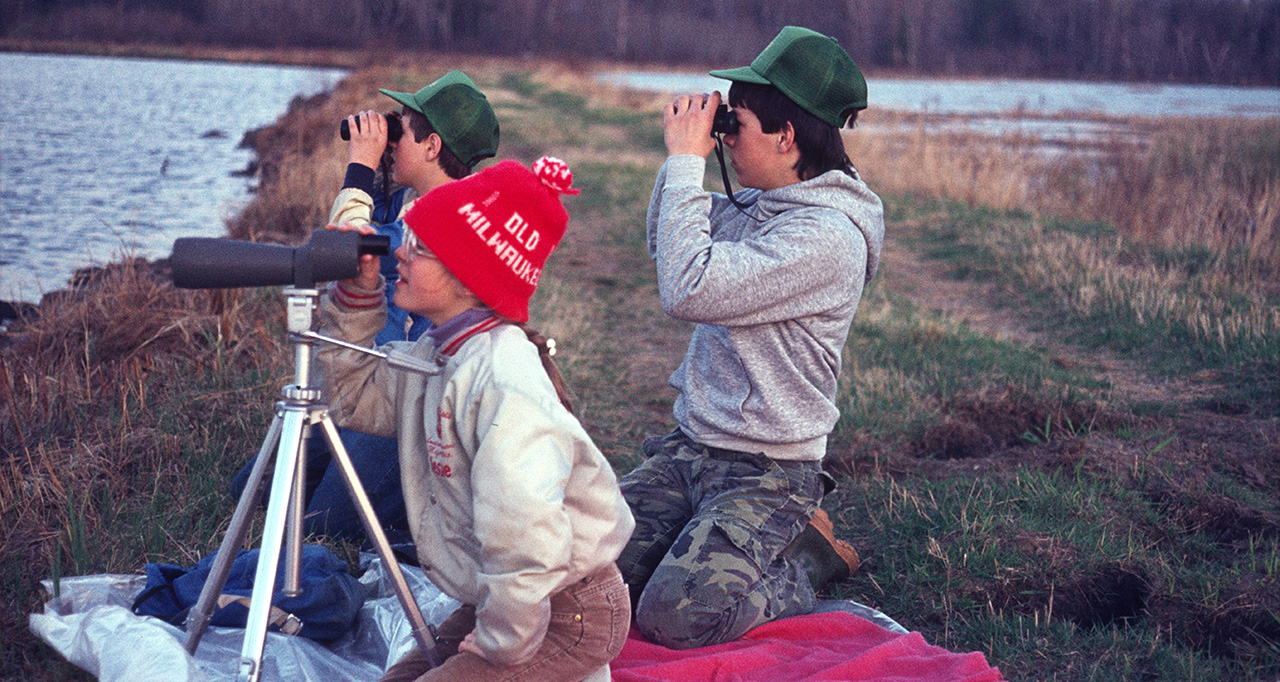
Top photo: Eau Claire County 4-H group participates in the 1985 Crane Count. The author’s daughter Jessica is in the foreground. Photo by Martin Voss