Rare Hybrid Wattled-Blue Crane Chick Hatches in South Africa
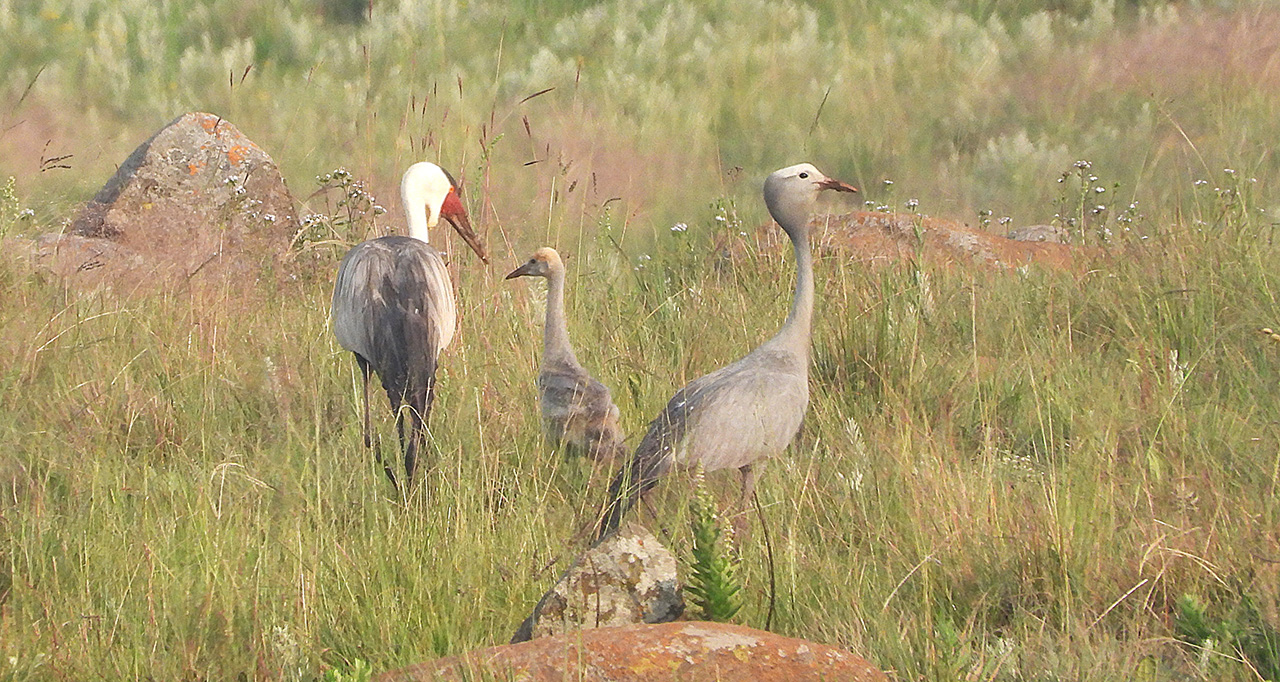
The blended family, with the Wattled Crane parent on the left and the Blue Crane on the right. The chick is approximately six weeks old in the photo. Jacquie Van Der Westhuizen/International Crane Foundation-Endangered Wildlife Trust Partnership
For the last few years, we have been receiving reports of a lone Wattled Crane among Blue Cranes in Mpumalanga province in eastern South Africa. Never in our wildest dreams did we think a Wattled Crane would pair up with a Blue Crane, but the inevitable happened. In early February 2026, I got a report from the local farmer, together with photo evidence, of the pair walking with, yes, a CHICK!
There are not many known cases of hybridization such as this, and even fewer documented, so I went up to Mpumalanga to see for myself. I spent a few days monitoring, photographing, and documenting the behaviour between the adult Wattled and Blue Crane and their chick. At that point, I guessed the chick was approximately five to six weeks old and resembled a Wattled Crane chick in appearance and size—see above photo.
In the normal life cycle of a Wattled Crane, chicks fledge at approximately five months. At around 10 months, the parents take them to a floater flock, a group of cranes that are not yet of breeding age or are not paired, and leave them there to grow up, find a mate, and begin the whole circle of life.
We decided to ring the chick, so we could identify it in the future when it joined a flock and see if it eventually paired with another crane and bred. We also collected genetic samples, which would give us a better idea of the hybrid crane’s genetic makeup and the bird’s sex. At this point, the chick was approximately 13 to 14 weeks old but looked more like a Blue Crane with a smaller bill and head and Blue Crane colouring.
The juvenile crane has since fledged, so sightings have been fewer as they move around, making it difficult to monitor. It was seen a few days ago, and, interestingly, he now looks more like a Wattled Crane, with lighter neck colouring, a grey back, and is almost as big as a Wattled Crane but as fast as a Blue Crane when he runs!!
In the animal kingdom, hybridized species are generally infertile. Still, none other than the International Crane Foundation’s Co-Founder, Dr. George Archibald, has confirmed that hybridization between Brolga and Sarus Cranes in Australia occurs, results in fertile chicks, and is actually more common than one realizes. We have no evidence to prove this in Wattled/Blue Crane hybrids, as very few cases have ever been documented.
One reason these types of hybridizations occur is habitat loss, which in turn leads to the decline of cranes in certain areas. When crane numbers drop, in this case, Wattled Crane numbers declined dramatically, the remaining few cranes start mingling with other crane species and eventually pair up.
We have seen a significant decline in the number of Wattled Cranes in Mpumalanga over the past 20 years, a province once home to the second-largest population outside KwaZulu-Natal, South Africa. This has led the Endangered Wildlife Trust/International Crane Foundation partnership to implement a research project in Mpumalanga to investigate the causes of the decline and how we can improve key crane habitats to bring back this amazing, iconic species!
 Story submitted by Jacquie Van Der Westhuizen, Farmer Partnerships and Outreach Specialist – South Africa
Published June 19, 2026