South Africa
A Partnership to Conserve South Africa’s Cranes
The South Africa Program is a fully integrated partnership between the International Crane Foundation and the Endangered Wildlife Trust, with a primary focus on the conservation of Blue, Grey Crowned, and Wattled Cranes in South Africa and on supporting crane conservation efforts in Namibia and Zimbabwe. The program is implementing two model projects: our long-term commitment to sustaining conservation through sustainable carbon-offset financing and protected area expansion in the Drakensberg region, and a second project focusing on Blue Cranes as ambassadors for an integrated conservation-agriculture landscape in the Karoo and Western Cape regions.
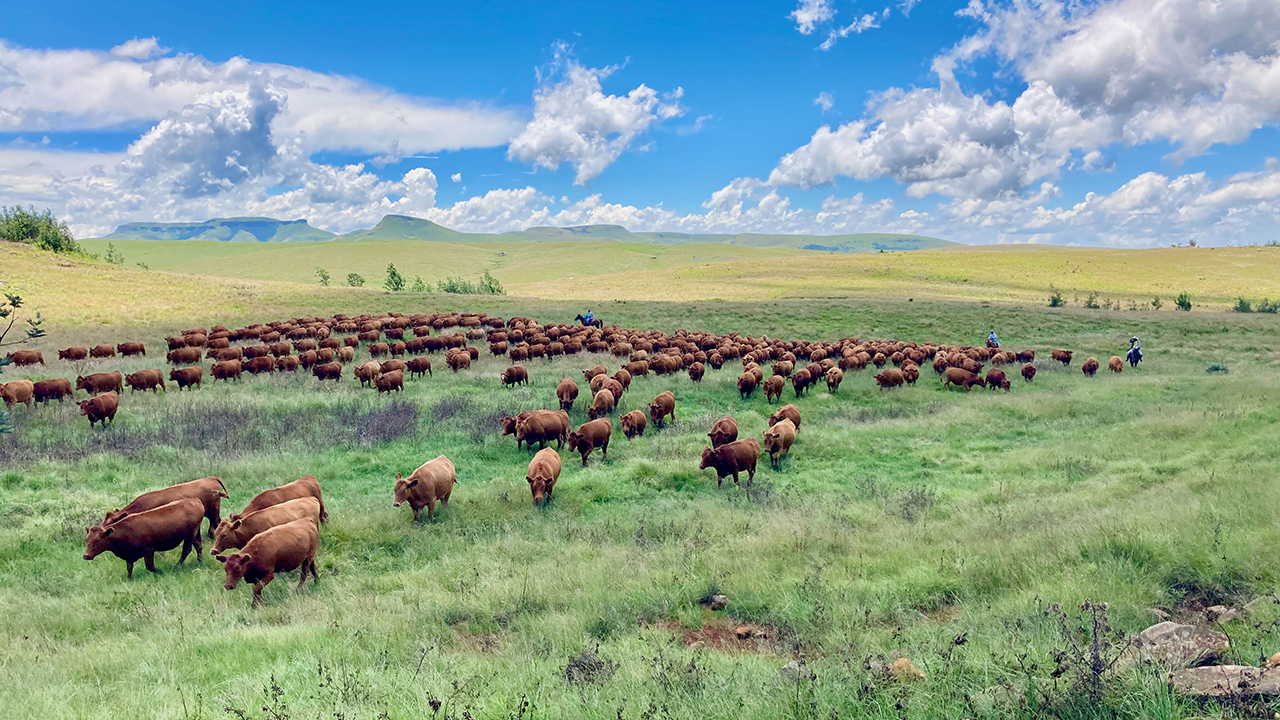
Managed rangeland participating in the carbon offsetting project. Photo by Pieter Botha/International Crane Foundation-Endangered Wildlife Trust
Our Innovative Approach
Sustaining Biodiversity, Water Resources, Agricultural Productivity, and Soil Carbon Sequestration through Long-Term, Sustainable Carbon Financing in the Drakensberg of South Africa
The Drakensberg region of South Africa is a high-biodiversity landscape, with diverse grasslands and wetlands that support 95% of South Africa’s Vulnerable Wattled Crane population, 70% of South Africa’s Endangered Grey Crowned Crane population, substantial numbers of Vulnerable Blue Cranes, and many other rare and endemic bird species. The Drakensberg is also a Strategic Water Source Area, providing much of South Africa’s water supply. However, the region’s biodiversity and water resources are under severe threat from intensifying and expanding agricultural and mining activities. Across South Africa, more than 50% of natural wetlands have been lost, and only 3% of the grassland biome is protected.
To sustain cranes, grasslands, and water resources across the Drakensberg, we work with landowners to improve agricultural productivity, water storage, and carbon sequestration on their farms, while enhancing biodiversity values. We have already facilitated the declaration of 145,000 ha of private and communal land as protected areas under the South African Biodiversity Stewardship Program, thereby improving their management. Within this landscape, our carbon offsetting project provides financial backing and guidance to improve rangeland management through rotational grazing and landscape-level fire management. The project covers more than 73,000 hectares and is managed through conservation stewardship agreements. Revenues from the sale of Verified Carbon Units generated by our project are distributed to participating farmers to support their improved land-use practices and are reinvested in core project management needs, including biodiversity stewardship actions.
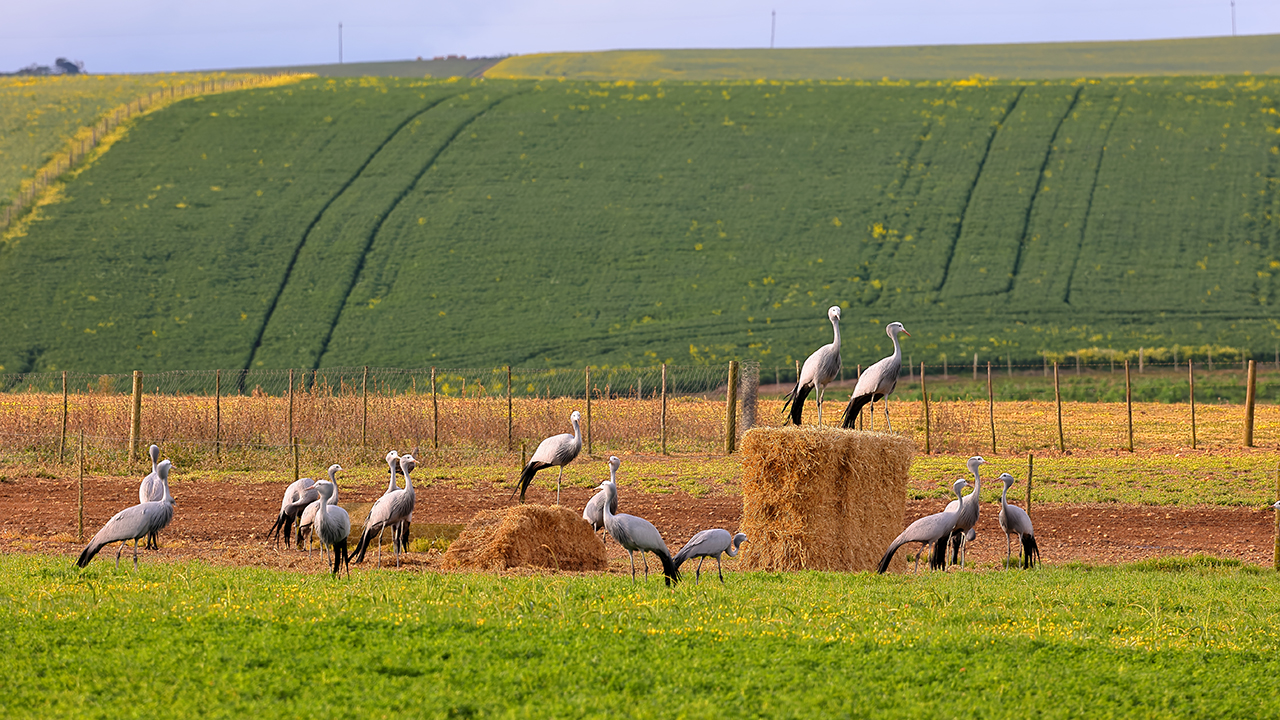
Blue Cranes forage in a harvested field in the Western Cape of South Africa. Photo by Pieter Botha/International Crane Foundation-Endangered Wildlife Trust
Blue Cranes – Ambassadors for an Integrated Conservation-Agriculture Landscape
The Vulnerable Blue Crane, a near-endemic species of South Africa, has declined significantly between 1978 and 1998. While the decline occurred mainly in the grassland and Karoo biomes of South Africa, its impact was buffered as the species artificially expanded its range into the Western Cape wheatlands in the mid-1900s. The population in this expanded range has increased steadily for several decades, so that around 60% of the Blue Crane population is now found in the Western Cape. This newly established population faces significant challenges, as cranes are frequently affected by powerline collisions, fence entanglements, poisoning, and agricultural changes. Recent research indicates a 42% decline in the Overberg region of the Western Cape between 2010 and 2019, and a similar trend in the Karoo. Research on Western Cape Blue Cranes over the last six years has flagged concerns about reduced breeding success and adult survival.
We are undertaking a new model project that targets Blue Cranes and biodiversity conservation on commercial agricultural landscapes in the Karoo and Western Cape regions. We will expand the area under crane-friendly farming and reduce crane mortalities caused by powerlines and other infrastructure in these regions. We will partner with and work directly with the farming community, and build a strong farm-extension network to support landowners in protecting and managing their land in ways that conserve Blue Cranes and enhance biodiversity on their farms, while also improving farming practices and yields. We will continue our work with Eskom, the power utility company in South Africa, to ensure that high-risk powerlines are properly marked and that proposed power infrastructure is sited away from high-risk areas. We will better model, identify, and mitigate threats to cranes, particularly those linked to renewable energy developments and range expansion driven by agriculture.
Top photo: Pieter Botha/International Crane Foundation-Endangered Wildlife Trust
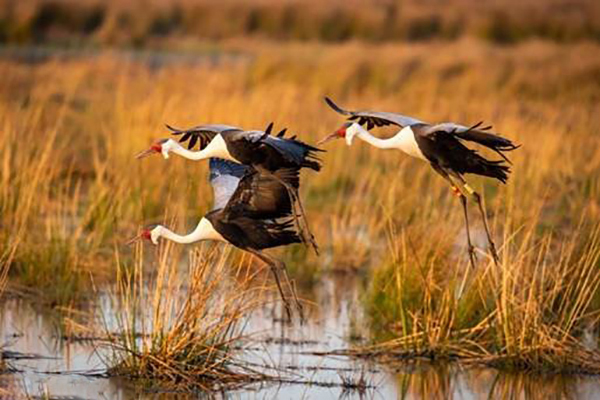
Wattled Cranes in flight by Daniel Dolpire
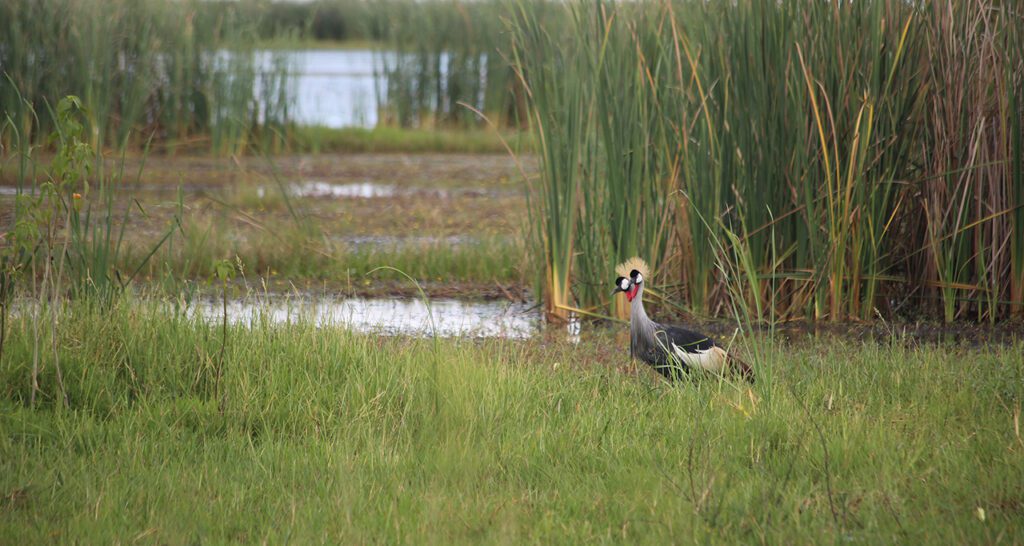
The International Crane Foundation in Africa calls for governments, organisations, and individuals to work alongside traditional custodians to restore wetlands for a secure future of cranes and people ahead of World Wetlands Day to be celebrated on 2nd February under the theme “Wetlands and Traditional Knowledge: Celebrating Cultural Heritage.”
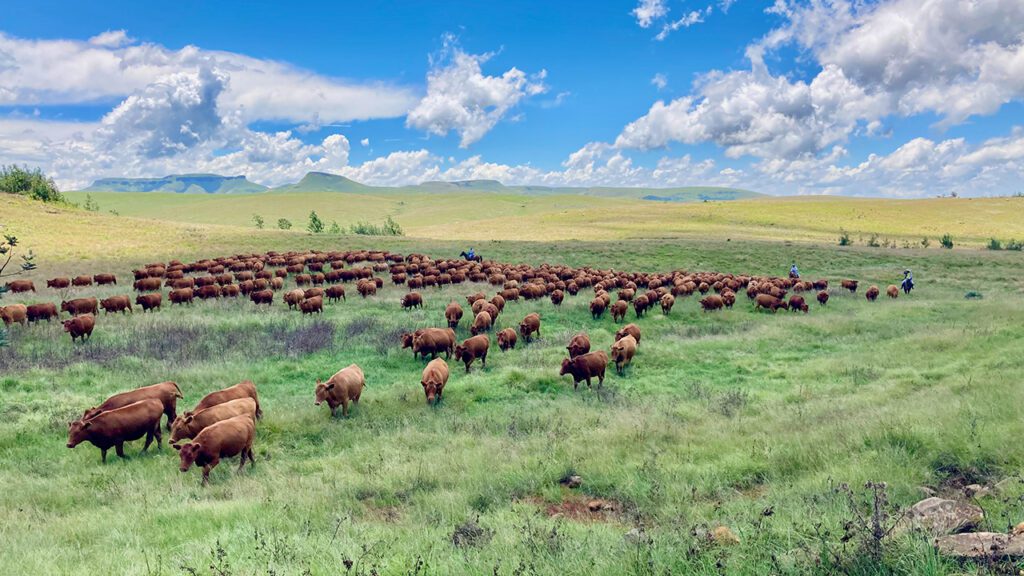
More than 90,000 hectares (222,600 acres) of irreplaceable Drakensberg Grasslands will now be conserved as part of South Africa’s first large-scale, verified soil carbon project.
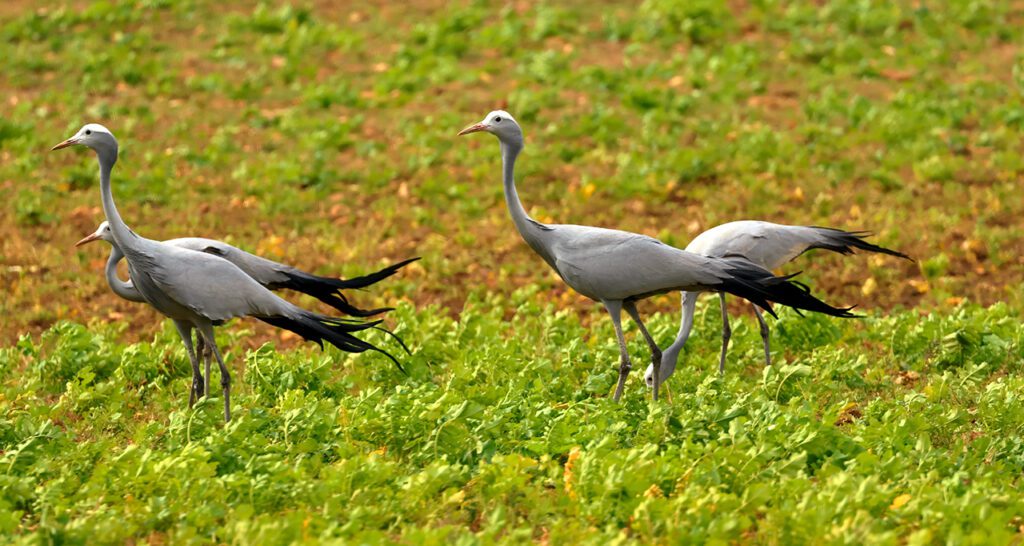
As South Africa celebrates Heritage Month, and ahead of marking Heritage Day on September 24, the Endangered Wildlife Trust/International Crane Foundation partnership has launched its new Blue Crane project focusing on habitat restoration, addressing threats posed by infrastructure, collaborating with partners such as farmers, and monitoring and research.