A Legacy of Conservation—the Overberg Crane Group
For more than three decades, the Overberg Crane Group (OCG) has played a central role in protecting South Africa’s national bird, the Blue Crane, across the Overberg landscape. Founded in 1991 in response to a series of catastrophic poisoning events, the group grew into one of the region’s longest-running community-driven conservation initiatives.
At the time of its formation, the future of Blue Cranes in the Overberg looked uncertain.
Blue Cranes faced many threats, and the high mortality rate highlighted the vulnerability of the species in an agricultural landscape. But this in turn sparked a collective determination among farmers, conservationists and authorities to work together to protect cranes.
From the outset, the OCG was built on partnerships and trust. Farmers and landowners, who manage most of the Overberg’s landscapes where cranes live and breed, became central to the conservation effort. Working alongside conservation organisations and authorities such as CapeNature, the Endangered Wildlife Trust, and the South African Crane Working Group, the OCG helped create a model of collaborative conservation rooted in the realities of a working agricultural landscape.
Over the next 35 years, this collaboration delivered important successes
Through farmer engagement, awareness programmes and monitoring, the Overberg became recognised as one of the most important regions for Blue Cranes in South Africa. The OCG’s role included extension support to farmers, a ringing project to track the movements of Blue Cranes, working with schools to raise awareness, and even playing a key role in the launch of the Coordinated Avifaunal Road (CAR) counts in South Africa.
While working with partners across the landscape, Blue Crane numbers in the region increased over time. These gains were recognised nationally in 2015, when the Blue Crane was downlisted from Vulnerable to Near Threatened in South Africa, reflecting improved population trends.
Yet conservation is never static
Despite earlier successes, Blue Cranes continued to face a range of threats, many of which remain particularly relevant in the Overberg. These include poisoning, collisions with powerlines, agricultural challenges such as fence and baling twine entanglement, and disturbance during breeding, along with broader landscape changes affecting the species. As pressures on agricultural and natural landscapes continue to evolve, so too must the conservation response.
In 2025, the Blue Crane was again uplisted to Vulnerable in South Africa, serving as a clear signal that continued and coordinated conservation action is essential.
Against this backdrop, the Overberg Crane Group has entered a new chapter.
For many years, the OCG functioned as a volunteer-driven initiative supported by farmers, conservation organisations, and government partners. While this model proved remarkably effective, the increasing scale and urgency of conservation challenges now require greater institutional support, resources, and coordination.
A new chapter for the Overberg Crane Group
As a result, the work historically carried out through the OCG will now fall under the joint stewardship of the International Crane Foundation and the Endangered Wildlife Trust–two organisations with extensive experience in crane conservation both nationally and globally.
This transition marks the closing of one chapter in the OCG story, while strengthening the long-term future of crane conservation in the Overberg. But the core principle that defined the OCG remains unchanged: conservation depends on partnerships.
As such, the future of Blue Cranes in the Overberg will continue to rely on the commitment of landowners, farmers, and local communities who share their landscapes with these iconic birds. It will also depend on the ongoing collaboration between conservation organisations, government authorities, and research partners.
As the next chapter of the OCG begins, that legacy continues to secure a future for Blue Cranes in the Overberg.
The people behind the Overberg Crane Group
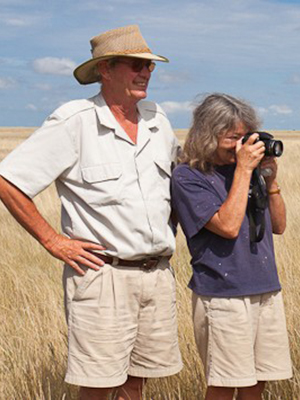
Ann and Mike Scott
Former CapeNature staff members, Ann and Mike Scott will forever be remembered in the Overberg for their role in co-founding the Overberg Crane Group. Back in 1991, when they were both based at De Hoop Nature Reserve, they learned of a mass poisoning event. Some 50 Blue Cranes had been found poisoned on a farm near Bredasdorp; most were dead, but nine were still alive. Saving those that did survive served as the inauspicious beginning for their ongoing commitment to Blue Cranes, and the start of the OCG.
Mick D’Alton
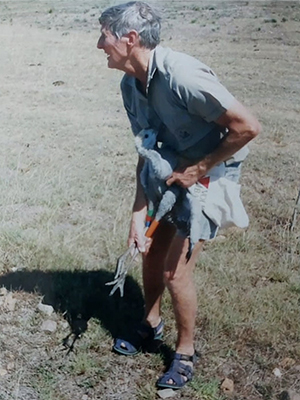
Since the start of the Overberg Crane Group 35 years ago, farmer Mick D’Alton has come to the aid of many injured Blue Cranes in the Overberg. He’s also seen the pure courage shown by these incredible birds. Ann and Mike Scott first explained the plight of the Blue Crane and the massive threat that they were under with numbers plummeting and poisoning incidents increasing in the early 1990s. And that sparked his involvement in the founding of the OCG, and his commitment to Blue Cranes ever since.
Hennie Lötter
Caledon farmer, Hennie Lötter passed away in 2011. But his legacy lives on in the Blue Cranes he played a role in protecting, serving as a founder member of the OCG.
Hennie became involved in crane conservation, joining the team that placed rings on the legs of young Blue Cranes, in order to identify individuals and better understand their movements within South Africa. And he implemented many conservation measures on his own farm to protect Blue Cranes. For example, he included steps in the water troughs so that Blue Crane chicks could escape drowning by climbing out.
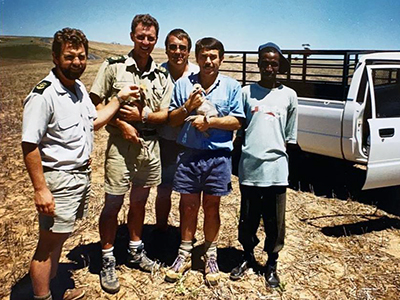 Hennie Lötter, second from right
Wicus Leeuwner
After reading about the plight of the Blue Crane in the local Caledon newspaper, and learning of an upcoming meeting, Wicus “gate-crashed” what would become the OCG’s founding gathering, representing the farming community. From that moment on, he became a passionate advocate, spreading the word about the cranes and inspiring fellow farmers to care as deeply as he did. By hosting researchers on the farm while they worked in the veld, he also gained many opportunities to capture striking photographs – images that would go on to play an important role in raising awareness and sharing the story of these birds with a wider audience.
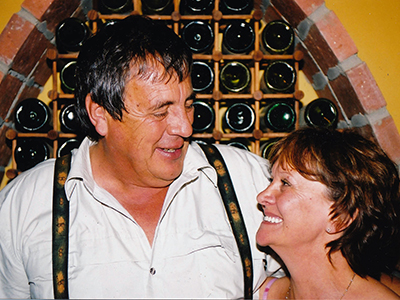 Wicus Leeuwner, left
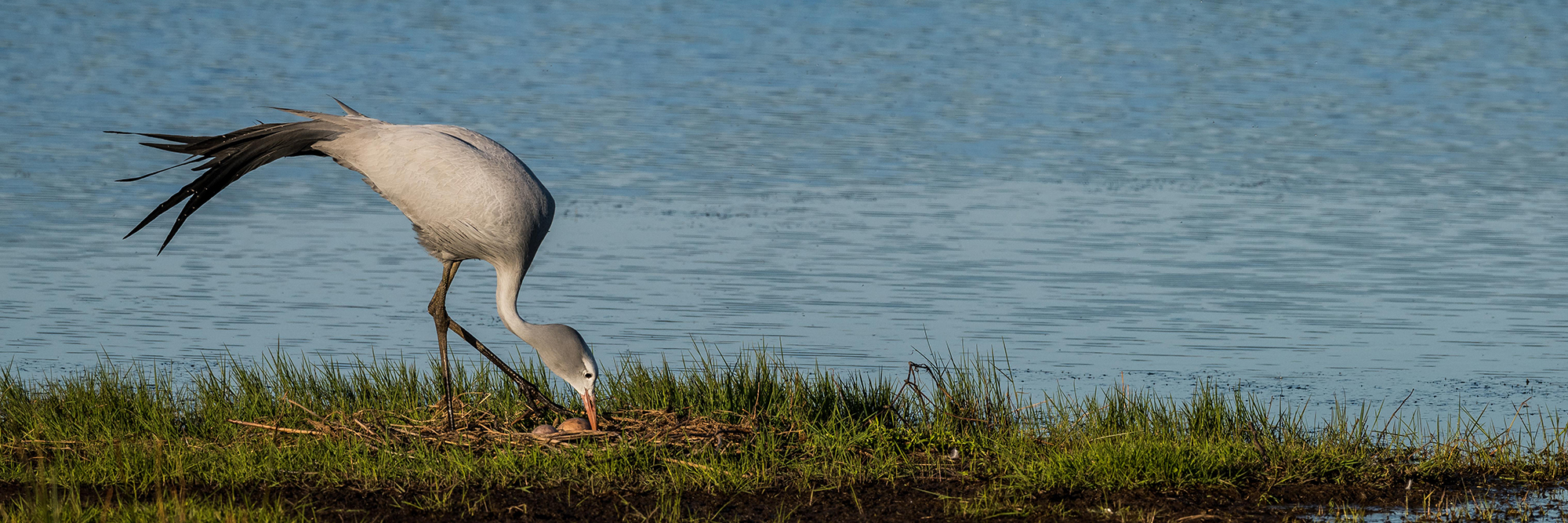
Top photo: A Blue Crane tends its nest in South Africa. Derek Greene